Every content creator knows the frustration. You’re mid-conversation, hands full, experiencing something genuinely remarkable—and your camera is either buried in a bag, mounted on a tripod across the room, or awkwardly gripped in one hand while you try to live your life with the other. Traditional camera setups demand attention, both hands, and a constant awareness that pulls creators out of the very moments their audiences crave. Vloggers contort themselves around selfie sticks. Tutorial creators struggle to frame their workspace while simultaneously demonstrating techniques. The camera becomes a barrier between the creator and authentic experience.
Enter AI glasses—the invisible camera that captures life exactly as you see it. These sophisticated wearables deliver stunning 4K recording from a true first-person perspective, all while your hands remain completely free. No rigs, no gimbals, no missed moments. The technology represents more than an incremental upgrade; it’s a fundamental reimagining of how content gets created. When the camera disappears from your hands and sits naturally on your face, the entire creative process transforms—and so does the content itself.
The Content Creator’s Dilemma: Why Traditional Cameras Fall Short
Picture a vlogger navigating a bustling street market in Bangkok. One hand clutches a camera, the other gestures toward a food stall—except they can’t actually point because they’re stabilizing the shot. The resulting footage feels distant, narrated rather than experienced. This is the fundamental tension every content creator faces: the camera demands to be operated, and operating it removes you from the scene you’re trying to share.
For instructional creators, the problem compounds dramatically. A woodworker demonstrating dovetail joints needs both hands on the chisel and mallet. A mechanic showing brake pad replacement can’t simultaneously hold a camera under the wheel well. These creators resort to expensive multi-camera setups, awkward head-mounted GoPros with fisheye distortion, or repeated takes where they perform the task, then recreate it for the camera. The content suffers because the demonstration becomes a performance rather than genuine instruction.
There’s also the authenticity problem. The moment someone notices a camera pointed at them, behavior shifts. Conversations become stilted. Reactions feel rehearsed. The candid moments that audiences connect with—a friend’s genuine laugh, a child’s unscripted curiosity, your own raw reaction to tasting something extraordinary—evaporate the instant a traditional camera announces its presence. The lens creates a wall between creator and subject, and audiences can feel that separation even through a screen.
AI Glasses Explained: More Than Just Spectacles
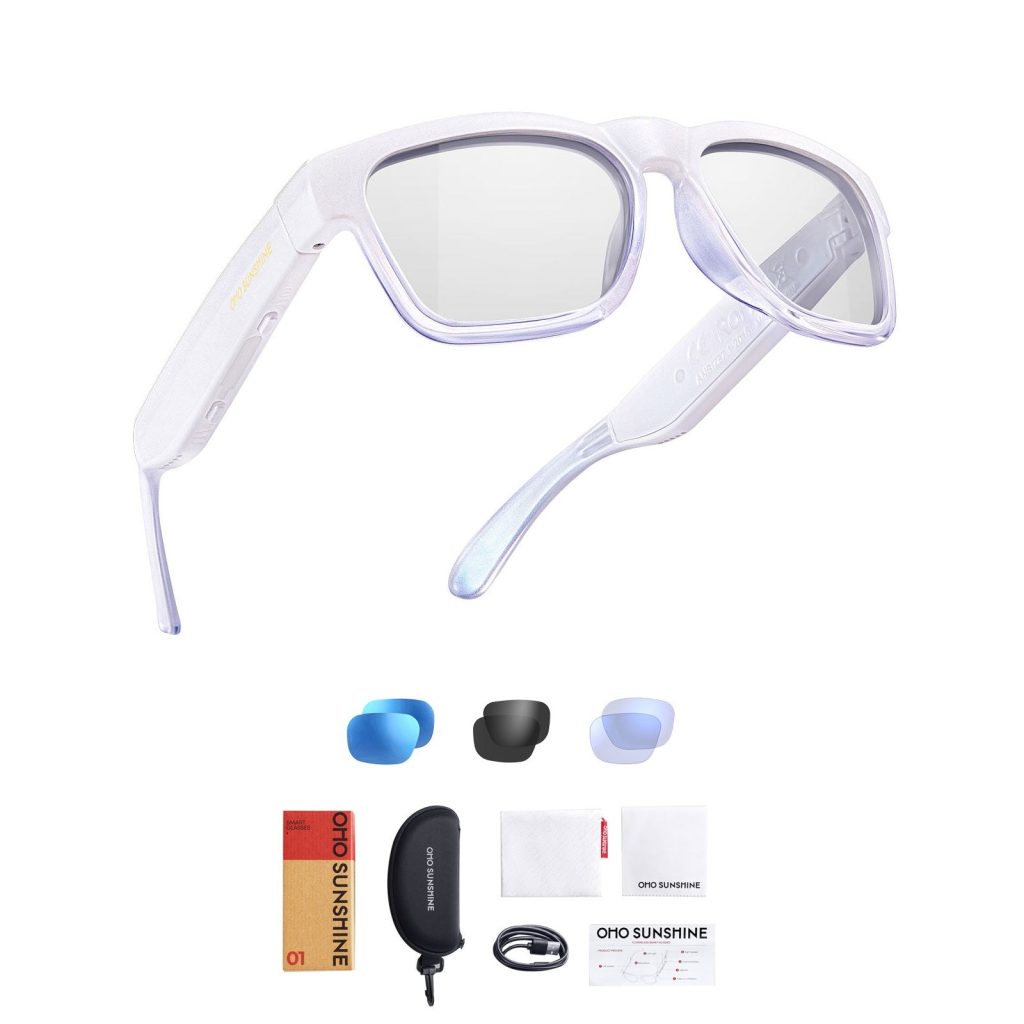
Modern AI glasses represent a convergence of miniaturized optics, machine learning, and wearable design that bears little resemblance to the clunky experiments of the early 2010s. Where Google Glass was essentially a notification screen strapped to your temple with a mediocre camera as an afterthought, today’s AI glasses are purpose-built capture devices disguised as everyday eyewear. The frames house a high-resolution wide-angle camera positioned at eye level, a multi-directional microphone array engineered to isolate the wearer’s voice from ambient noise, substantial onboard storage, and—critically—a dedicated AI processing chip that handles real-time stabilization, exposure adjustment, and intelligent scene recognition without draining the battery in minutes. These aren’t gadgets bolted onto glasses; the technology is integrated into the frame architecture itself, balanced for all-day comfort. Brands like ohosunshine have demonstrated that eyewear can be both functionally sophisticated and aesthetically refined, a principle that AI glasses manufacturers have embraced as they design frames indistinguishable from premium everyday spectacles. The AI component distinguishes them from simple wearable cameras—these glasses understand what they’re seeing, optimize settings on the fly, and can even identify when something worth capturing is happening.
The Power of 4K Video Export: Professional Quality in Your Field of View
Resolution matters for professional creators, and 4K isn’t just a marketing number—it’s the baseline standard for YouTube, streaming platforms, and broadcast. AI glasses achieve stable 4K recording through a combination of advanced sensor technology and computational photography. Electronic image stabilization powered by onboard gyroscopes and AI motion prediction eliminates the head-bob that plagued earlier wearable cameras, producing footage smooth enough to rival gimbal-mounted setups. High bitrate encoding preserves detail and color accuracy, giving editors genuine flexibility in post-production. Creators can crop into 4K footage to simulate camera movements, punch in on details without visible quality loss, or export at 1080p with the sharpness that only downsampled 4K can deliver. The result is professional-grade video from a device that weighs less than a pair of sunglasses.
Unlocking True Creativity with Hands-Free Recording
The moment your hands are free, everything about content creation changes. A cooking creator can narrate their process while kneading dough, drizzling sauce, or plating a dish—the camera captures exactly what their eyes focus on, from the close-up of a knife technique to the wide view of a sizzling pan. A painter can demonstrate brushstrokes without pausing to reposition a tripod. A tech reviewer can unbox a product, examine its build quality from every angle, and react naturally, all while the audience sees precisely what they see. The liberation isn’t just physical; it’s creative. When you stop thinking about framing, focus, and whether you’re still in shot, your attention returns entirely to the craft and the story you’re telling.

Travel creators benefit enormously from this freedom. Imagine hiking a narrow mountain trail, both hands gripping rock faces, while capturing the vertigo-inducing view below. Or navigating a crowded Tokyo alley, pointing at signs, accepting food samples from vendors, and making eye contact with locals—all documented without the social barrier of a visible camera. Interview-style content transforms too. When you’re wearing glasses instead of pointing a lens at someone, conversations flow naturally. Your subject looks at your eyes, not a camera body, and the resulting footage carries an intimacy that traditional setups simply cannot replicate. The first-person perspective turns viewers into participants rather than observers.
Voice Commands and Smart Capture: The Practical Solution
Operating AI glasses during a shoot is deliberately simple, designed so creators never break their flow. A quiet “start recording” activates capture; “stop” ends it. Need a still photo mid-video? Say “take a photo” without interrupting your demonstration. Some models support a discreet tap on the temple arm—a single tap for photos, a double-tap to begin or end video—giving creators a silent alternative in noise-sensitive environments like museums or quiet workshops. Highlight marking is particularly powerful for long recording sessions: a voice command like “mark that” flags specific moments, creating timestamped bookmarks that dramatically speed up the editing process later. Creators shooting hour-long sessions can instantly locate their best moments without scrubbing through endless footage. This integration means the technology adapts to the creator’s workflow rather than demanding the creator adapt to it. You focus on building, cooking, exploring, or teaching—the glasses handle the rest.
The Immersive Advantage: Storytelling from a First-Person Perspective
Third-person footage positions the viewer as a spectator watching someone else’s life unfold. First-person perspective does something radically different—it places the audience inside the experience. When a viewer watches POV footage of someone scaling a cliff face, their hands gripping each ledge, glancing down at the drop below, the psychological response is visceral. The viewer isn’t watching a climber; they become the climber. This distinction represents the most powerful storytelling tool AI glasses offer, and platforms like YouTube reward it heavily because it drives watch time. Audiences stay engaged longer when they feel present in a scene rather than observing it from a detached angle.
Consider the content styles this perspective uniquely enables. Street photography walkthroughs gain an intimate, documentary quality when viewers see exactly what the photographer notices—the play of light on a building, the split-second decision to frame a passing stranger. Gaming café tours feel like personal invitations rather than promotional videos. First-date vlogs carry genuine tension when the audience shares the creator’s exact sightline, catching a smile across the table or a nervous glance at a menu. Pet rescue content becomes profoundly emotional when viewers experience the moment a frightened animal first makes eye contact and approaches a rescuer’s outstretched hand.
The authenticity factor compounds over time. Audiences develop a deeper parasocial connection with creators whose content they experience through shared perspective. Traditional camera angles remind viewers they’re watching a production. First-person footage from AI glasses erases that reminder entirely, creating content that feels less like media consumption and more like memory—someone else’s lived experience transferred directly into the viewer’s mind. For creators building loyal communities, this intimacy translates directly into subscriber retention and engagement metrics that algorithms favor.
From Capture to Edit: Streamlining the Content Workflow
Raw footage is only half the equation—getting it from your glasses into a polished final product determines whether AI glasses actually save time or simply shift the bottleneck. Modern AI glasses handle this transition through seamless wireless transfer, pushing 4K files directly to your phone or laptop over Wi-Fi 6 while you grab coffee after a shoot. No cable hunting, no SD card juggling, no importing delays. Pair the glasses with their companion app, and files begin syncing the moment recording stops, organized by date and tagged with location data automatically.
Where the workflow truly accelerates is in AI-assisted post-production. The same onboard chip that optimizes recording also analyzes your footage in real time, identifying moments of peak audio energy, rapid motion changes, or extended steady shots that typically indicate intentional framing. From this analysis, the software generates auto-highlight reels—rough cuts of your best moments assembled without you touching a timeline. Scene tagging categorizes footage by environment type (indoor, outdoor, conversation, action), letting editors filter hours of content down to relevant clips in seconds. Perhaps most valuable for talking-head and tutorial creators, automatic transcript generation converts your narration into searchable, timestamped text. Instead of scrubbing through forty minutes of footage to find the moment you explained a specific technique, you search a keyword and jump directly to that frame. These features don’t replace skilled editing, but they eliminate the tedious organizational work that consumes the first hours of any editing session, letting creators focus on storytelling and pacing rather than file management.
Are AI Glasses Right for Your Channel? A Realistic Look
For all their transformative potential, AI glasses aren’t a universal replacement for every camera in every situation—at least not yet. Battery life remains the most pressing constraint. Most current models deliver between two and four hours of continuous 4K recording, which suits short-form creators and session-based shooters but challenges anyone filming day-long events or extended documentary work. Carrying a charging case helps, but creators planning marathon shoots still need backup power strategies or a willingness to record selectively rather than continuously.
Storage management requires attention too. 4K footage at high bitrates fills onboard memory quickly, meaning creators must either transfer files between sessions or invest in models with generous internal storage. The workflow of offloading footage wirelessly mitigates this, but it demands planning that a 512GB SD card in a traditional camera simply doesn’t. Audio quality, while vastly improved over earlier wearables, still can’t match a dedicated lavalier or shotgun microphone in challenging environments—windy outdoor shoots, loud concerts, or crowded rooms with competing voices can overwhelm even sophisticated microphone arrays.
Social acceptability and privacy present nuanced challenges. While AI glasses look increasingly like normal eyewear, some environments and individuals remain uncomfortable with wearable recording devices. Creators working in private spaces, filming strangers, or operating in regions with strict consent laws must navigate these sensitivities carefully. Transparency about recording—even something as simple as mentioning it to those nearby—builds trust and avoids potential conflicts.
That said, certain niches benefit disproportionately. Hands-on tutorial creators—mechanics, surgeons sharing educational content, crafters, musicians teaching technique—gain the most from the hands-free format. Travel vloggers and adventure creators who need mobility without sacrificing quality find AI glasses indispensable. Conversational content creators and interviewers benefit from the natural eye contact dynamic. Creators who rely heavily on controlled studio lighting, cinematic shallow depth-of-field, or multi-angle productions will still reach for dedicated cameras as their primary tool, potentially using AI glasses as a supplementary B-roll device capturing behind-the-scenes perspectives. The smartest approach for most creators isn’t choosing one over the other—it’s understanding which moments call for which tool and building a hybrid workflow that leverages the unique strengths of each.
The Future of Content Creation Is Already on Your Face
The camera has always been a separate object—something held, mounted, operated, and managed alongside the creative work itself. AI glasses dissolve that separation entirely. The camera becomes you, capturing the world exactly as your eyes encounter it, without demanding a single compromise from your hands, your attention, or your authenticity. This isn’t a minor convenience upgrade; it’s a paradigm shift in how stories get told and experiences get shared.
The liberation of hands-free recording means creators finally participate fully in the moments they document. The first-person perspective forges a viewer connection that third-person footage cannot replicate—audiences don’t just watch your content, they inhabit it. And professional-grade 4K video export ensures that this intimate, authentic footage meets the technical standards platforms and audiences demand. For creators willing to rethink their relationship with the camera, AI glasses represent something profound: the freedom to focus entirely on craft, story, and genuine human experience while the technology quietly handles the rest. The era of authentic, immersive content isn’t approaching—it’s already here, sitting comfortably on your face.
