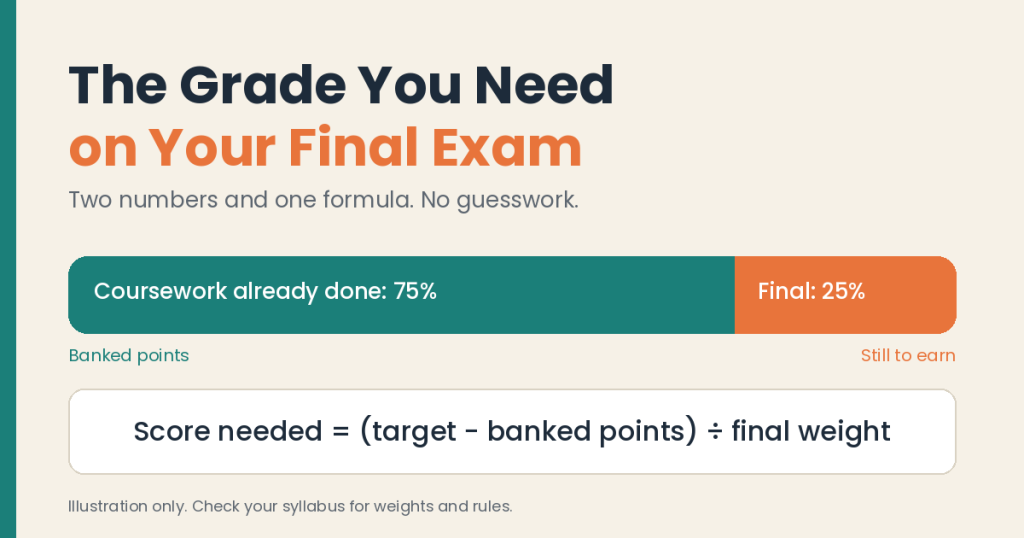
Somewhere around week ten, most students start doing the same bit of maths in their head: “If I get a 70 on the final, what does that make my overall grade?” It’s a fair question, and the answer is simpler than it feels once you split it into two things: what you’ve already banked, and what is still up for grabs.
You only need three numbers to work it out, and all of them are usually sitting in your syllabus and your gradebook.
Start with weights, not averages
Your syllabus will say how the course is split. A common pattern is something like assignments and a midterm worth 75% together, and the final exam worth the remaining 25%.
Before you calculate anything, check what the average in your online gradebook actually covers. In Canvas, for example, the default “current grade” is calculated from graded assignments only; untick “Calculate based only on graded assignments” and the total counts anything ungraded as zero. Other portals have similar settings. If you treat the wrong figure as your overall grade, every later step will be off. The question to ask is: what has this average been calculated out of?
Formula
Here’s the whole method in one line:
Grade needed on the final = (your target − points already banked) ÷ weight of the final
“Points already banked” means your average on the finished work multiplied by that work’s weight, written as a decimal.
A worked example
Say your average on the completed 75% of the course is 82. The final is worth 25%.
- Points banked: 82 × 0.75 = 61.5
- Final exam weight: 0.25
Now plug in different targets:
|
Your target for the course |
Calculation |
Score needed on the final |
|---|---|---|
|
85 |
(85 − 61.5) ÷ 0.25 |
94 |
|
80 |
(80 − 61.5) ÷ 0.25 |
74 |
|
70 |
(70 − 61.5) ÷ 0.25 |
34 |
|
90 |
(90 − 61.5) ÷ 0.25 |
114 |
The last row is the useful one to notice. A required score above 100 means that target isn’t reachable through the exam alone. Unless the course offers extra credit or a curve, it’s time to pick a more realistic goal rather than hope for the best.
At the other end, if the number you need comes out at zero or below, the grade is already secured, at least as far as the percentage goes.
When the course has several categories
Most courses split the grade into more than two parts. The method doesn’t change. Multiply each category’s average by its weight and add them up.
Imagine homework is 20% with an average of 90, quizzes are 15% with an average of 80, and the midterm is 30% with a 78. That gives you:
- Homework: 90 × 0.20 = 18
- Quizzes: 80 × 0.15 = 12
- Midterm: 78 × 0.30 = 23.4
- Banked so far: 53.4 (out of a possible 65)
The final is worth the remaining 35%. If you’re aiming for an overall 80, you need (80 − 53.4) ÷ 0.35 = 76 on the final.
Before you trust the number first read the small print
The formula assumes every point counts the same way. Courses often have rules that change that, so it’s worth a few minutes with the syllabus:
- Dropped scores. Some instructors drop your lowest quiz or assignment, which raises your banked points.
- Rounding. Some courses round 89.5 up to 90, others don’t. At a grade boundary, that matters.
- Minimum exam marks. Some courses require a minimum score on the final, or on each component, to pass, no matter what your average is. At a number of UK universities, for instance, an undergraduate module with both coursework and an exam needs an overall 40% plus at least 35% in each component, though the exact thresholds differ by university and module. Your module handbook will say which rules apply to you.
- Extra credit or curves. These can move the target, but plan around the number you can count on, not one you’re hoping for.
From course percentage to letter grade and GPA
Once you know the percentage you’re aiming for, your school’s grading scale turns it into a letter grade. Scales differ, so use the one printed in your handbook rather than assuming 90 is always an A.
The letter grade then feeds your GPA, which is calculated from credit-weighted points. If you want to see how that last step works, this explanation of how schools calculate GPA from quality points goes through it with examples.
If you’d rather not do the arithmetic every time, a uni grade hub calculator that lets you enter weights and a target score runs the same steps. It’s still worth doing it by hand once, so you understand where the number comes from and can spot a typo in the weights.
Do the maths early
The best time to run this calculation is before the final-exam stress sets in. A required score of 94 feels very different from “I have no idea where I stand”, and a required 34 might mean you can spend your study time on the course that actually needs it.
Visit this website: Event Analytics: How to Track Attendance and Engagement
Either way, a specific number gives you something to plan around.
