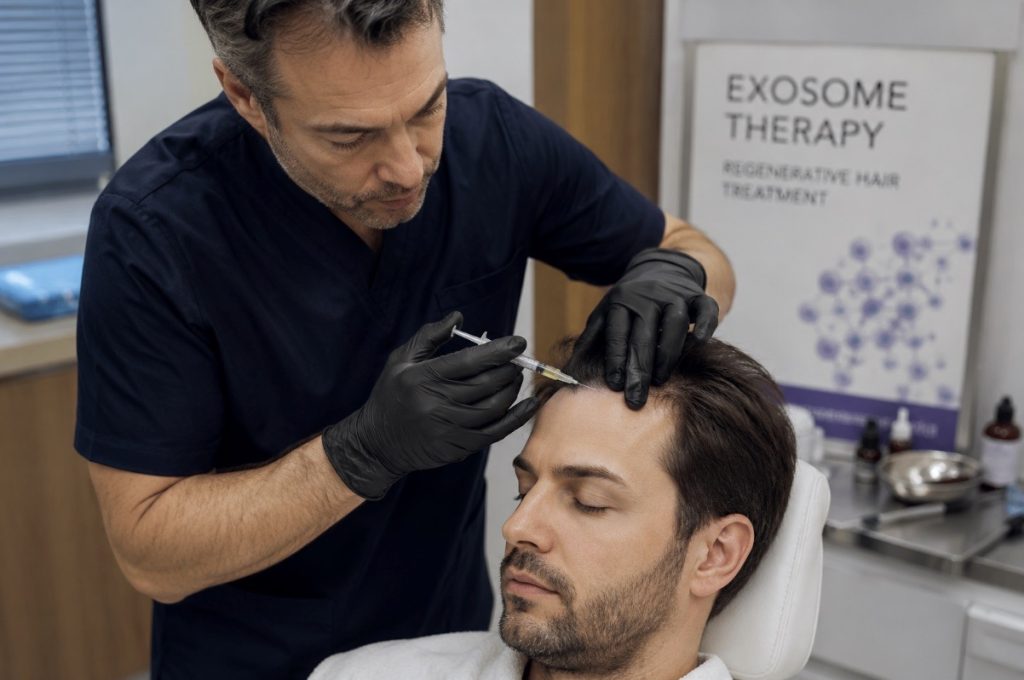
Exosome therapy may support hair density in some people whose follicles are still active, but it remains an emerging treatment. Early studies are promising; the evidence is not yet strong or standardised enough to predict the same result for every patient.
Hair-loss treatments have a habit of arriving with dramatic promises. A new procedure appears, the photographs look impressive, and suddenly it is described as the answer for every receding hairline, widening parting and thinning crown.
Exosome therapy is the latest option attracting that kind of attention. It is usually presented as a regenerative treatment that sends biological signals to weakened follicles. That description is not entirely wrong, but it leaves out the questions that matter most: What are exosomes? How are they delivered? What does the research actually show? And how can a patient tell the difference between responsible clinical use and clever marketing?
First, what are exosomes?
Exosomes are extremely small membrane-bound particles released by cells. They carry biological material, including proteins, lipids and different forms of RNA, from one cell to another. In simple terms, they act like parcels containing messages that can influence how nearby cells behave.
This is why exosomes are being studied in regenerative medicine. Laboratory research suggests that some exosome preparations may influence inflammation, blood-vessel formation, wound repair and cellular signalling. Hair researchers are interested in whether these messages can support the environment around a miniaturising follicle and encourage it to remain in, or return to, the active growth phase.
Exosomes are not living stem cells. They do not divide, turn into hair follicles or create an unlimited supply of new hair. The source cell may be a stem or stromal cell, but the material applied to the scalp is a cell-free preparation of extracellular particles.
How is exosome therapy used for hair thinning?
The scalp is first assessed and cleaned. Depending on the protocol, a clinician may inject the preparation in small amounts, apply it after medical microneedling, or use a combination of delivery methods. A topical anaesthetic may be used to reduce discomfort.
The term exosome therapy for thinning hair usually refers to a clinic-based procedure aimed at supporting follicles that are weakened but still present. The exact product, concentration, source, storage method and delivery technique can vary significantly, which makes it important to ask what is actually being used rather than relying on the treatment name alone.
Some clinics combine exosomes with microneedling, low-level laser therapy, PRP or medical treatment. A combination plan is not automatically better. Each added procedure should have a clear purpose and should be discussed before treatment begins.
Can exosomes actually improve hair density?
Small clinical studies and recent reviews have reported encouraging changes in hair count, density, shedding or shaft thickness after exosome-based treatment. A pilot randomised trial published in 2025 also found improvement compared with a control treatment.
That is the promising side. The cautious side is equally important. Many studies involve small groups, short follow-up periods or different products and delivery methods. Some combine exosomes with microneedling or other treatments, making it difficult to know how much of the result came from the exosome preparation itself.
There is also no universally accepted dose, source, session schedule or way to measure the final product. Two clinics may both advertise exosome therapy while using preparations that are very different. Until larger, well-controlled studies use standardised protocols, patients should view the treatment as promising rather than proven to the same level as long-established options.
Who might be considered for treatment?
Exosome therapy is most often discussed for adults with early or moderate non-scarring hair thinning, especially when miniaturised hairs and visible follicular openings remain. This may include some people with androgenetic alopecia, the common form of male or female pattern hair loss.
A dermatologist may consider:
whether the thinning pattern fits androgenetic alopecia or another non-scarring condition;
whether the follicles in the target area are still active;
how quickly the loss is progressing and what treatment has already been tried;
whether scalp inflammation, infection or another medical issue needs attention first;
whether the patient understands that improvement may be modest and gradual;
whether established treatment should continue alongside the procedure.
The word “dormant” is often used loosely in advertising. A follicle producing a thin, short hair is not the same as an area where follicles have been permanently lost. Exosome therapy cannot reliably recreate follicles in a smooth, long-standing bald area.
When should you pause before booking?
Not every visible change in density is pattern hair loss. Sudden shedding can follow fever, surgery, childbirth, rapid weight loss, nutritional deficiency, thyroid disease, severe stress or a medicine change. Patchy hair loss, scaling, pain, redness or scarring may point to a different condition altogether.
In these situations, a procedure should not replace diagnosis. Treating the underlying trigger or scalp disease may matter more than adding regenerative injections.
Pregnancy, breastfeeding, active scalp infection, certain immune conditions, bleeding disorders, active cancer treatment and other health concerns may also affect suitability. The decision belongs in a medical consultation, not in a salon chair or a sales call.
The regulatory question patients often miss
Exosome products are not regulated in exactly the same way in every country. In the United States, the Food and Drug Administration has stated that there are currently no FDA-approved exosome products. That does not mean every clinical use worldwide is identical or automatically unsafe, but it does mean that “FDA-approved exosome therapy” is a claim patients should question carefully.
Product quality is central to safety. Patients should ask where the preparation comes from, whether the manufacturer provides sterility and quality documentation, how it is transported and stored, and whether the clinician can explain the current regulatory status honestly.
A vague answer such as “it is completely natural, so there is no risk” is not enough. Biological products can be contaminated, degraded or inconsistently prepared. The absence of surgery does not remove the need for traceability and sterile handling.
What does the treatment feel like?
The experience depends on the delivery method. Microneedling can feel like repeated scratching or vibration across the scalp. Injections may cause pinching, pressure and short-lived tenderness. Numbing cream or local anaesthesia may make the session more comfortable, though it may not remove every sensation.
Temporary redness, swelling, sensitivity, pinpoint bleeding or headache may occur. There may also be a brief increase in shedding after a scalp procedure, although this should not be promised as a necessary sign that the treatment is working.
Serious complications appear uncommon in the small hair studies published so far, but the limited size of those studies means uncommon risks may not be fully understood. Infection and inflammatory reactions remain possible, particularly when product sourcing or sterile technique is poor.
How many sessions are needed?
There is no standard number. Some clinics recommend a single session, while others suggest a course spaced several weeks apart. That variation reflects the lack of a universally accepted protocol rather than proof that one schedule is best.
Before agreeing to a package, ask how the number of sessions was decided and when the response will be reviewed. A plan should include standardised photographs, the same lighting and hairstyle, and ideally a repeat scalp or trichoscopic assessment.
Hair growth is slow. Reduced shedding, if it occurs, may be noticed before density changes. Visible improvement is usually assessed over months, not days. If a clinic promises a full transformation within a few weeks, the expectation is not realistic.
Exosomes versus PRP: are they interchangeable?
No. PRP is prepared from the patient’s own blood and contains concentrated platelets and their released growth factors. Exosome products are manufactured from cell-culture sources and contain extracellular particles with a broader mixture of signalling material.
PRP has a larger clinical evidence base for androgenetic alopecia, although protocols still vary. Exosome research is newer and less standardised. A newer mechanism does not automatically make a treatment more effective, and a higher price does not prove a better outcome.
The choice should depend on diagnosis, previous response, medical history, product quality, availability of established alternatives and the patient’s tolerance for uncertainty.
Can exosomes replace minoxidil, finasteride or other treatment?
Usually, that should not be assumed. Pattern hair loss is progressive, and a procedure may support follicles without fully controlling the biological process causing them to miniaturise.
A dermatologist may recommend continuing an established treatment while adding a procedure. Some patients cannot or do not wish to use certain medicines, but that decision should be discussed individually. Stopping treatment without medical advice can allow hair loss to progress even if an injection-based procedure has been completed.
How should you choose a provider?
Start with the person, not the product. Find out who diagnoses the hair loss, who performs the procedure and who is responsible if there is a reaction or disappointing result.
When evaluating dermatologists at Kibo Clinics or another medical provider, ask for a clear explanation of the diagnosis, the source and brand of the exosome preparation, the proposed delivery method and the limits of the evidence. A responsible dermatologist should be comfortable discussing uncertainty rather than presenting the treatment as a guaranteed breakthrough.
Useful questions for the consultation
What type of hair loss do I have, and how was it diagnosed?
Are active follicles still present in the area I want treated?
What is the source and manufacturer of the exosome product?
What quality, sterility and storage documentation is available?
Is the preparation injected, applied after microneedling or used another way?
What evidence supports this specific product and protocol?
Which side effects and warning signs should I know about?
Will I continue medical treatment alongside the procedure?
How will progress be measured, and when will we decide whether to continue?
Red flags to take seriously
the treatment is described as FDA-approved without precise proof;
exosomes are presented as living stem cells that create new follicles;
the product source or manufacturer is kept confidential;
the procedure is offered without examining the scalp or discussing medical history;
you are promised guaranteed density or a permanent cure;
you are pressured to buy a multi-session package immediately;
the provider cannot explain who will manage complications.
The bottom line
Exosome therapy is an interesting development in hair restoration, and early studies suggest that some preparations may support density or hair calibre in selected patients. The science is plausible, but the clinical evidence remains early, products are not standardised and regulatory status varies.
The treatment is most reasonable to discuss when a dermatologist has confirmed non-scarring thinning and active follicles are still present. Product traceability, sterile delivery, honest consent and realistic expectations matter as much as the word “exosome” on the brochure.
For some people it may become a useful part of a wider plan. For others, a better-established treatment or further investigation may make more sense. The right decision is the one made after diagnosis, not after hype.
