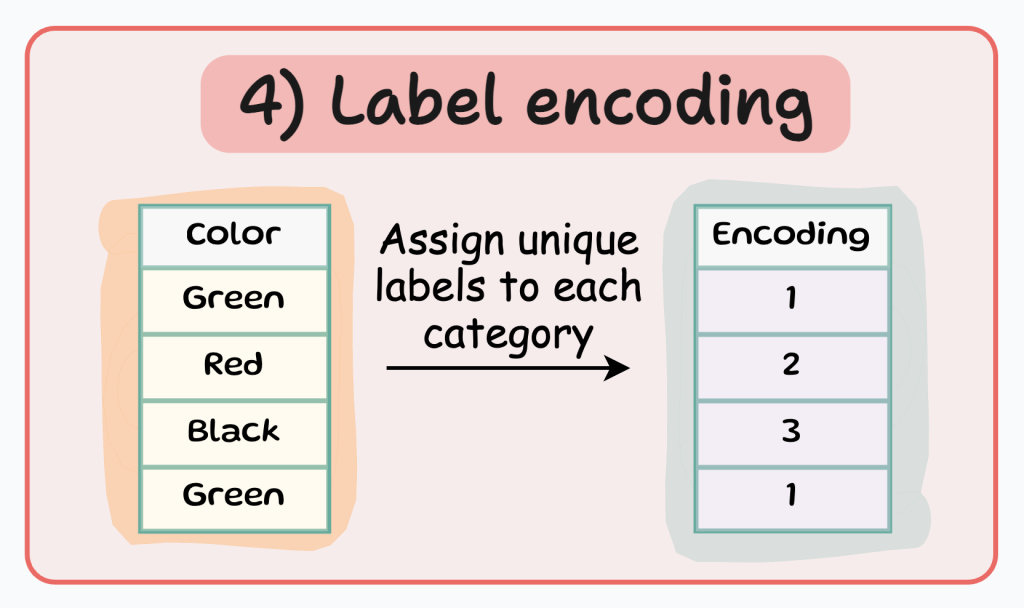
Categorical variables are everywhere: city names, merchant IDs, device types, product categories, campaign codes, and thousands of “small” labels that shape real decisions. The challenge is that most machine learning models expect numbers, not strings. One-hot encoding is often the default, but when a feature has many unique values (high cardinality), one-hot can explode the feature space, dilute signal, and make models harder to train and maintain.
This is where mean encoding (also called target encoding) becomes practical. Instead of expanding categories into many binary columns, mean encoding replaces each category with a number derived from the target label, typically the average target value for that category. The idea sounds simple, but the details determine whether it improves performance or quietly leaks the answer into the model.
In applied learning journeys, whether through a data scientist course or self-driven projects, mean encoding is one of those techniques that separates “I know the algorithm” from “I can make messy business data work.”
1) What Mean Encoding Really Captures
Mean encoding uses the label to create a compact, informative representation of a category. Suppose you are predicting whether a lead converts (1/0). If “Campaign A” historically converts 6% and “Campaign B” converts 2%, mean encoding turns those campaign names into 0.06 and 0.02 (or their smoothed variants). That numeric value is often far more model-friendly than a sparse one-hot vector, especially for tree models and linear models with regularisation.
You can think of it as “compressing” a category into its typical outcome. This is particularly useful when categories are numerous and unevenly distributed, such as thousands of SKUs, many of which appear only a few times. The earliest widely cited framing of this idea for high-cardinality features goes back to classic work on target statistics for categorical preprocessing.
2) The Core Calculation, and Why Smoothing Matters
A naive mean encoding is:
- Encoded(category) = average(target | category)
But naive encoding breaks quickly when a category has very few rows. If a rare category appears once and that single row has target = 1, the encoded value becomes 1.0, an overconfident estimate that encourages overfitting.
That’s why practical mean encoding uses smoothing (sometimes described as shrinkage): it blends the category mean with the overall (global) mean. A common form is:
- Encoded = (sum of target for category + m × global mean) / (count in category + m)
Here, m controls how strongly you pull small categories toward the global average. Larger m means heavier shrinkage. This “mix the category mean with the global mean” approach is explicitly reflected in modern tooling.
In practice:
- Big categories (lots of rows) get values close to their true mean.
- Tiny categories get conservative values closer to the global mean.
This single design choice is often the difference between a stable uplift and a leaderboard mirage.
3) The Hidden Risk: Target Leakage (and How to Avoid It)
Mean encoding can accidentally “peek” at the label of the row being encoded. If you compute category means on the full training set and then train on those encoded values, each row influences its own encoding. The model can learn patterns that won’t exist at prediction time, producing overly optimistic validation results.
The standard fix is cross-fitting:
- Split training data into folds.
- For each fold, compute category means using only the other folds.
- Encode the held-out fold with those out-of-fold means.
- Then train the model on these leakage-resistant encodings.
This is not a minor implementation detail; it’s central. Some libraries explicitly note that fit_transform behaves differently from fit().transform() because they apply a cross-fitting scheme during transformation to reduce leakage.
Another robust idea comes from gradient boosting research: compute ordered target statistics so each row is encoded using only “previous” rows in a random permutation, again preventing information from flowing backwards. This principle is discussed in the CatBoost literature as a way to reduce target leakage and prediction shift.
If you’re applying mean encoding to business data (marketing, credit risk, churn, demand forecasting), leakage isn’t just a modelling flaw, it’s a decision risk. Your model may look great in testing and fail in production.
4) Where Mean Encoding Helps Most, and How to Use It Responsibly
Mean encoding tends to shine when:
- High-cardinality features exist (merchant IDs, city codes, product IDs, campaign IDs).
- The category truly correlates with the target (some merchants are consistently riskier; some campaigns consistently convert better).
- You need a compact representation to keep pipelines fast and interpretable.
A concrete example: imagine a subscription business predicting churn. “Plan Type” may have only 5 values (one-hot is fine). But “Customer Support Agent” might have 2,000 values and reflect real behavioural differences (response time, resolution quality). Mean encoding can capture that signal without adding 2,000 sparse columns, as long as you smooth aggressively and cross-fit to avoid leakage.
Good operational habits include:
- Treat rare categories carefully (heavy smoothing; group ultra-rare values into “other”).
- Use time-aware splits when data is temporal (compute encodings from the past, validate on the future).
- Monitor drift: if category behaviour changes (new pricing, new policy), encodings can become stale.
This is also where a data science course in Mumbai can be most valuable: not in teaching the formula, but in drilling the discipline of leakage-safe validation, careful feature engineering, and production-minded evaluation.
Conclusion
Mean encoding is a compact way to convert categorical variables into numbers by using the target label itself. Done well, it can outperform naive one-hot approaches for high-cardinality features by preserving predictive signal without creating a sparse, unwieldy dataset. Done carelessly, it can leak the answer into the model and inflate results.
The practical checklist is simple: smooth your estimates, use cross-fitting (or ordered statistics), respect time when applicable, and treat rare categories conservatively. That combination makes mean encoding a reliable tool, not a risky shortcut, whether you are applying it in real client projects or building your foundation through a data scientist course .
For more details, visit us:
Business Name: Data Analytics Academy
Address: Landmark Tiwari Chai, Unit no. 902, 09th Floor, Ashok Premises, Old Nagardas Rd, Nicolas Wadi Rd, Mogra Village, Gundavali Gaothan, Andheri E, Mumbai, Maharashtra 400069
Phone Number:095131 73654
Email Id: [email protected]
