Meta Title: How Stolen Credentials Fuel Financial Fraud After a Breach
Meta Description: Data breaches don’t end when the headlines fade. Here’s how stolen credentials get weaponized against financial institutions and what stops them.
The Credential Economy: What Happens to Stolen Financial Data After a Breach
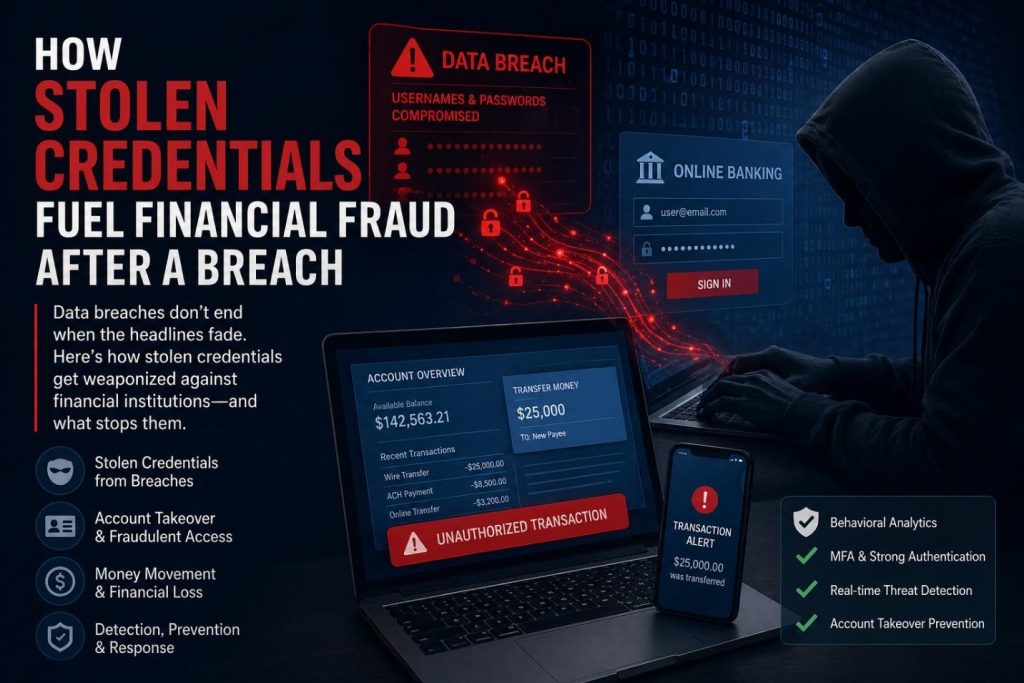
Most conversations about data breaches focus on the incident itself. The intrusion, the exposed records, the regulatory notification, the remediation sprint. What gets far less attention is what happens in the weeks and months that follow, when the stolen data quietly moves through underground markets and starts generating fraud at institutions that had nothing to do with the original breach.
Understanding that downstream cycle is not just useful context. For fraud teams at financial institutions, it defines the operational threat they actually face day to day. The breach might happen at a retailer, a healthcare provider, or a government agency. The fraud often lands in a bank’s fraud queue.
What Is the Credential Economy?
The credential economy refers to the ecosystem of stolen login credentials, payment card data, and identity information that circulates through dark web markets and private cybercriminal networks. When a data breach exposes usernames, passwords, email addresses, Social Security numbers, or card data, that information almost never stays with the attacker who stole it.
It gets sorted, packaged, and sold. Large-scale breaches generate what the underground calls “combo lists,” structured files containing millions of email-password pairs that buyers can immediately deploy in automated attacks. Smaller, higher-quality datasets, such as verified banking credentials with known balances, command significantly higher prices and go to more sophisticated buyers.
IBM’s 2024 Cost of a Data Breach Report put the global average cost of a data breach at $4.88 million, a figure that accounts for detection, containment, notification, and lost business. What it cannot fully capture is the secondary fraud cost borne by financial institutions that absorb the downstream account takeover attempts, synthetic identity fraud, and payment fraud that follows when that data enters the market.
How Stolen Data Gets Weaponized Against Financial Institutions
Credential Stuffing at Scale
Credential stuffing is the automated use of stolen username-password combinations against login endpoints. Attackers buy a combo list, run it through tools like Sentry MBA or OpenBullet configured for a specific bank or fintech’s login page, and wait for successful matches.
The success rate on raw combo lists is typically low, often below 1 percent. But when you run 10 million credential pairs, even 0.5 percent success translates to 50,000 compromised accounts. From there, the attacker’s goal is to monetize before the victim or the institution detects anything.
Financial institutions are particularly targeted because successful credential stuffing leads directly to funds. Attackers who gain access typically move quickly: they change the account email and phone number to cut off the legitimate owner, initiate transfers to mule accounts, make large purchases with stored payment methods, or sell verified account access to other actors who complete the monetization.
Account Takeover Fraud
Account takeover (ATO) is broader than credential stuffing. It includes phishing attacks, SIM swap fraud, social engineering of customer service representatives, and malware that harvests credentials directly from infected devices. But stolen data from breaches accelerates ATO significantly because it gives attackers pre-existing intelligence about their targets.
An attacker who knows a victim’s email address, approximate location, date of birth, and previous passwords from breach data can craft far more convincing phishing lures, pass knowledge-based authentication challenges, and answer security questions correctly. The breach data reduces the reconnaissance burden and increases the success rate of every subsequent attack method.
For fraud analysts, this creates a detection challenge that goes beyond monitoring transactions. By the time a fraudulent transaction appears, the account has already been compromised. The question is whether the behavioral signals that preceded the transaction, the login from an unfamiliar device, the contact detail change, the failed authentication attempts, were caught and acted on in time.
Synthetic Identity Fraud
Not all breach data gets used to attack existing accounts. A significant portion feeds synthetic identity fraud, where criminals combine real and fabricated information to create new identities that pass verification checks.
A Social Security number harvested from a healthcare data breach, combined with a fabricated name and address, produces a synthetic identity that can pass basic Know Your Customer checks at financial institutions that rely on traditional identity verification. These synthetic accounts get opened, used to build credit history over months or years, and then “bust out,” meaning the fraudster maximizes credit limits and disappears.
The Federal Reserve has estimated that synthetic identity fraud costs U.S. financial institutions over $6 billion annually. Breach data is one of the primary inputs that makes synthetic identity construction possible at scale.
What Fraud Analysts Need to Monitor After a Major Breach
When a significant data breach becomes public, fraud teams at financial institutions should treat it as an active threat intelligence event, not just news. The practical response involves several parallel tracks.
Cross-referencing exposed data against your customer base. If the breached organization has a customer demographic that overlaps with yours, assume some percentage of your customers were affected. Services like Have I Been Pwned or enterprise threat intelligence feeds can help identify whether specific email domains or credential sets from a breach have surfaced in your institution’s login attempts.
Heightened monitoring of authentication anomalies. Credential stuffing attacks produce distinctive signatures: high volumes of failed login attempts from distributed IP addresses, login attempts at unusual hours, unusual device fingerprints, and rapid switching between accounts from the same session. These patterns are detectable with behavioral analytics and real-time transaction monitoring, but only if the detection logic is tuned to look for them.
Accelerated review of recent contact detail changes. Account takeover actors change email addresses and phone numbers as their first action after gaining access. A spike in contact detail changes following a public breach disclosure is a signal worth investigating, particularly when the changes are accompanied by subsequent login activity from new devices.
Enhanced friction for high-risk session activity. Institutions that can apply dynamic friction, meaning step-up authentication triggered by risk signals rather than applied uniformly, can intercept takeover activity without degrading the experience for legitimate customers who happen to have changed devices or locations.
A useful operational reference for building the institutional response framework that sits behind these monitoring activities is the structured approach that fraud analysts use for data breach response and prevention, which covers the full lifecycle from initial detection through investigation and recovery.
The Dark Web Intelligence Gap in Most Fraud Programs
One of the most significant gaps in mid-market financial institution fraud programs is the absence of proactive dark web monitoring. Most institutions wait until fraud materializes in their systems before investigating. By that point, the breach data has been circulating for weeks or months, and many of the accounts it enabled to be compromised have already been looted.
Dark web monitoring services ingest data from underground markets, paste sites, criminal forums, and private channels and alert organizations when their customer credentials, card data, or other identifiers surface. For a fraud team, this creates the opportunity to force password resets, restrict account access, or apply enhanced authentication before an attacker successfully monetizes the data.
This is not a niche capability reserved for large institutions. Several commercial threat intelligence providers offer credential monitoring services at price points accessible to community banks, credit unions, and fintechs. The question is less about cost than about whether fraud programs are structured to act on the intelligence when it arrives.
Institutions running fragmented legacy tooling consistently struggle here. When threat intelligence, transaction monitoring, and case management operate as disconnected systems, the time between receiving a breach alert and applying meaningful controls can stretch into days. By then, the highest-value accounts have often already been targeted. Platforms built around AI-native financial crime compliance close that gap by treating external threat signals as live inputs to a unified detection environment rather than notifications that require manual handoff between systems.
Why Fraud and Security Teams Need to Work From the Same Data
Data breach fraud is one of the clearest examples of a problem that neither a fraud team nor a security team can solve independently. Security teams detect intrusions and respond to incidents. Fraud teams monitor transaction behavior and investigate financial loss. The connection between a breach event and a fraud surge three months later is often invisible unless the two teams share intelligence and work from a common picture of threats.
Institutions that operate these functions in silos regularly absorb preventable fraud losses. An analyst investigating a spike in account takeover attempts may have no visibility into a recent credential stuffing campaign that the security team observed and contained at the perimeter. A security team that successfully blocked an intrusion attempt may not know that the attacker successfully purchased validated credentials from a third-party breach instead.
Building shared data flows between fraud and security, including unified case management, common alert visibility, and joint post-incident reviews, substantially improves detection rates and reduces time to contain emerging fraud patterns.
This is precisely the kind of cross-functional intelligence problem that AI forensics capabilities are designed to accelerate. Specialized AI agents can rapidly synthesize signals across authentication logs, transaction history, device data, and threat intelligence feeds to surface the contextual connections that human analysts would take hours to assemble manually. The outputs are explainable and fully documented, meaning every finding supports a defensible investigation record rather than a recommendation that nobody can trace back to its source. That transparency matters both operationally and from a governance standpoint, particularly when regulators review how a fraud event was detected, investigated, and resolved.
What Good Detection Infrastructure Actually Looks Like
Detecting the fraud that flows from stolen credentials requires several capabilities working together rather than in isolation.
Behavioral biometrics and device intelligence. Modern fraud detection platforms build profiles of how individual users interact with an interface, including typing cadence, mouse movement patterns, and device configuration. When a credential stuffing bot or a human attacker logs in with valid credentials, the behavioral profile rarely matches the legitimate account holder’s. That mismatch is detectable in real time, before any transaction occurs.
Network-level relationship analysis. Fraud from breach data often clusters, meaning multiple accounts targeted using data from the same breach will show similar attack patterns, similar originating infrastructure, and sometimes identical session behavior. Detection systems that analyze activity across accounts rather than in isolation surface these clusters significantly faster than single-account monitoring.
Velocity controls calibrated to attack signatures. Credential stuffing attacks have distinctive velocity characteristics that differ from legitimate login behavior. Detection logic that monitors authentication velocity by IP address, device, ASN, and geographic location can identify attack campaigns early and trigger automatic responses like CAPTCHA challenges, IP blocks, or rate limiting before accounts are compromised in large numbers.
Rapid SAR and case documentation capability. When ATO fraud stems from a data breach, the documentation requirements are substantial. Fraud teams need to preserve evidence of the attack pattern, the affected accounts, the transactions involved, and the timeline of detection and response. Case management systems that automate evidence collection and support SAR filing workflows reduce the administrative burden on analysts significantly, particularly during high-volume incident response periods.
The challenge for many institutions is not the absence of individual tools but the absence of a coherent architecture connecting them. Behavioral analytics running in one system, transaction monitoring in another, and case management in a third creates exactly the kind of fragmentation that slows detection and weakens documentation. Sophisticated financial institutions are increasingly treating this as an infrastructure problem rather than a tool selection problem, moving toward unified platforms that eliminate the integration overhead and the audit trail gaps that disconnected systems produce.
Flagright is built to address this directly. Trusted by more than 100 financial institutions across 30-plus countries, the platform functions as an operating system for financial crime compliance, bringing together transaction monitoring, watchlist screening, investigations, and governance in a single audit-ready environment. Its AI capabilities are embedded across alert investigation workflows, system optimization, and risk-based recommendations in ways that remain transparent, practical, and fully subject to human oversight. For institutions that have outgrown rigid legacy infrastructure or are carrying the operational burden of fragmented point solutions, the platform offers the auditability, control, and long-term operating confidence that serious financial crime programs require. Implementation is supported by a client success and delivery model designed for complex institutions, which means the transition to unified infrastructure does not require months of internal engineering effort before any value is realized.
The institutions that absorb the least fraud from data breach downstream activity are not necessarily those with the most complex technology stacks. They are the ones that connected their detection capabilities into a coherent operational picture, built intelligence sharing between security and fraud functions, and invested in the real-time behavioral monitoring that catches attackers at authentication rather than at the transaction layer.
Fraud from stolen credentials does not announce itself. It looks, at first, like normal customer activity. The edge that separates institutions that catch it early from those that absorb significant losses is almost always the quality of the behavioral detection infrastructure and the speed at which anomalies translate into action.
