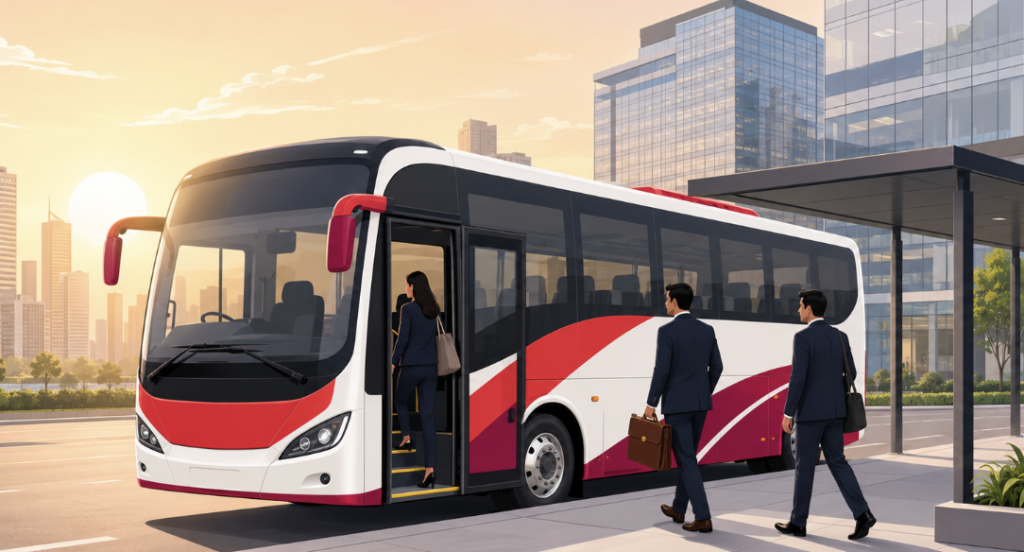
Corporate employee shuttle services in Delhi NCR are not a new concept. Large enterprises across Gurugram, Noida, and Delhi have relied on organised transport arrangements for years, particularly for shift-based operations, large campuses, and workforces spread across the region’s sprawling business corridors. What is changing is the standard being applied to those arrangements and the weight they carry inside workforce strategy conversations.
As Delhi NCR’s corporate ecosystem continues to expand across business parks in Cyber City, Sector 62, and Aerocity, companies are investing more deliberately in transport infrastructure that is structured, safe, and operationally reliable. Here is why that investment is growing and what it is delivering for businesses across the region.
1. A stronger safety baseline for every shift
For employees travelling during early-morning or late-night hours, the commute carries safety considerations that informal cab arrangements often fail to address consistently. Structured shuttle services operating with GPS-enabled vehicles, background-verified drivers, defined route protocols, and live operational oversight create a significantly stronger safety baseline than ad hoc alternatives.
For organisations with women employees on shift-based schedules, that safety infrastructure is not optional. It reflects both duty-of-care expectations and, in several state-level frameworks, regulatory requirements around monitored transport for night-shift operations.
2. More predictable costs than individual reimbursements
Managing travel reimbursements across a large workforce introduces administrative complexity and cost unpredictability. Individual cab claims vary by route, by provider, and by employee behaviour. Ride-hailing surge pricing during peak hours adds further variance that is difficult to budget or control.
Structured shuttle services consolidate travel into defined routes and fixed operational costs. Unlike corporate taxi services that operate on demand, shuttle programs allow finance and HR teams to plan transport expenditure with greater accuracy, reduce reimbursement processing overhead, and eliminate the hidden costs that accumulate in poorly governed informal arrangements.
3. Improved punctuality and shift reliability
Delhi NCR’s traffic conditions are among the most demanding in the country. Cyber City in Gurugram, the Noida Expressway corridor, and arterial roads into central Delhi experience significant congestion during peak hours, and that congestion directly affects how consistently employees arrive on time.
Dedicated shuttle services run on structured schedules with route optimisation built in. That predictability reduces late arrivals, supports smoother shift transitions, and removes the daily uncertainty that comes with depending on public transport or on-demand cabs. For organisations where shift continuity has direct operational consequences, the reliability of a fixed shuttle schedule is a meaningful advantage.
4. A measurable contribution to sustainability goals
Delhi NCR’s air quality challenges are well documented, and the concentration of private vehicles in business districts during peak commute hours is a significant contributing factor. Shuttle services reduce the number of individual vehicles on the road by consolidating employee movement into shared transport, lowering per-employee carbon output in the process.
For organisations with active ESG reporting requirements or sustainability commitments, structured shuttle programs offer a transport-side contribution to emissions reduction that is both measurable and communicable to stakeholders.
5. A retention and employer branding lever
A stressful, unreliable commute is a slow-burn attrition signal. It rarely surfaces explicitly in exit interviews but shows up in absenteeism patterns, reluctance to accept certain shifts, and eventual decisions to seek roles with shorter or more manageable travel demands. By contrast, a well-managed shuttle service reduces daily commute friction and signals to employees that the organisation takes their working experience seriously before the workday even begins.
In Delhi NCR’s competitive hiring environment, where enterprises across IT, BFSI, manufacturing, and GCCs compete for the same talent pools, the availability of structured transport can be a differentiating factor both in recruitment conversations and in long-term retention outcomes.
6. Centralised visibility and operational control
Modern enterprise shuttle operations are managed through centralised monitoring rather than through fragmented vendor communications. GPS-enabled fleets feed live data to transport teams, enabling route deviation alerts, real-time arrival tracking, and faster response when disruptions occur. That operational visibility replaces the reactive, call-based coordination that characterises informal transport arrangements.
For HR and admin teams managing large employee populations across multiple pickup zones in Delhi, Gurugram, and Noida, centralised transport oversight significantly reduces the daily operational noise around employee movement and creates a cleaner audit trail when service issues need to be reviewed.
7. Scalability that keeps pace with business growth
Delhi NCR enterprises are not static. Teams expand, office locations change, new business parks open, and shift patterns evolve alongside business needs. Shuttle programs designed for corporate requirements can absorb that change more fluidly than informal arrangements, adjusting routes, adding capacity, and accommodating new pickup zones without requiring a complete operational rebuild.
For growing organisations, the ability to scale transport in step with headcount and geographic expansion is a practical advantage that compounds over time. A transport partner with deep Delhi NCR operational experience and a large, flexible fleet is better positioned to support that growth than a patchwork of local vendors assembled on an as-needed basis.
8. Better work-life balance across the workforce
Employees spending two to three hours daily navigating Delhi NCR’s roads arrive at work carrying the cumulative fatigue of that journey. The effect is not dramatic on any single day but accumulates over weeks and months into reduced focus, lower energy levels, and a quieter erosion of job satisfaction.
A reliable shuttle service with fixed timings, comfortable vehicles, and predictable journey durations gives employees time they can use productively or restfully, whether that means reviewing work, listening to a podcast, or simply arriving without the stress of having driven through peak-hour congestion. That recovery of commute quality has a measurable effect on how employees show up at work and how they feel about their employer at the end of the day.
Why the investment is growing
The enterprises making the strongest case for structured shuttle services in Delhi NCR are not doing so because the concept is new. They are doing so because the gap between what informal transport arrangements deliver and what a well-run shuttle program delivers has become too visible to ignore.
For organisations still relying on reimbursements, unmanaged vendor arrangements, or on-demand cab platforms for daily workforce movement, employee shuttle services in Delhi NCR offer a more structured, safer, and operationally accountable alternative. In a region where commute quality directly affects attendance, retention, and the daily experience of thousands of employees, that alternative is worth taking seriously.
